


Продължение на част 1: Автор: Валентин Панайотов
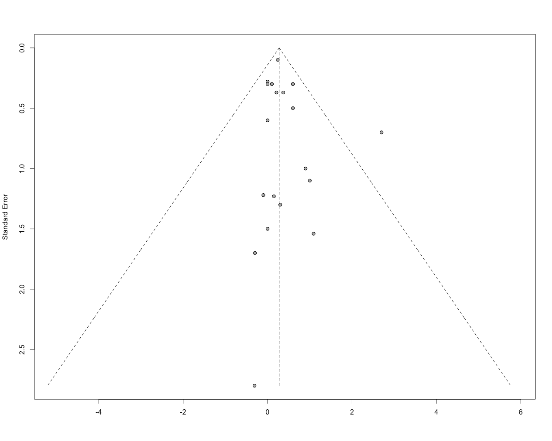
Фуниевидната графика на данните от цялостното изследване е представена на фиг 1.
Разпределението на резултатите е много близко до очакваното при липса на изкривяване в публикациите. Точките са разпределени равномерно върху или в близост до неутралната линия по цялото й протежение. Изключение представлява едно изследване, което е отклонено силно вдясно от нея. При това резултатът е със сравнително ниска стойност на разсейване и софтуерът му е поставил ниско тегло – 1.1% (вж. фиг. 2). Считаме, че наличието на една- единствена (сравнително) екстремна стойност не компрометира цялостната извадка и ще изключим хипотезата за наличие на отклонение в резултатите. Още повече, че всички останали точки (общо 19 на брой) са групирани в малка околност около неутралната линия.

Установените резултати представляват недвусмислено доказателство за ролята на физическите натоварвания в процеса на редукция на тегло. За особено важно заключение на базата на изследваните данни считаме, факта, че количеството на мускулната маса се запазва (или повишава) независимо от конкретния тип и параметри на физическата активност. По наше мнение, при стратифицирането на данните по характеристиките на натоварването би могло да се достигне до по-категорични изводи за това какъв точно тип физическа активност е най-благоприятен в процеса на редукция на тегло. Естествено, за постигането на тази цел е необходима значително по-голяма база данни от тази, с която разполагаме. Надяваме се, допълнителни бъдещи изследвания да успеят да хвърлят повече светлина върху изясняването на този важен проблем.
1. Croymans, DM et al., Effects of resistance training on central blood pressure in obese young men, J Hum Hypertens. 2014 March ; 28(3): 157–164.
2. Donnely, JE et al., Aerobic exercise alone results in clinically significant weight loss for men and women: Midwest Exercise Trial-2, Obesity (Silver Spring). 2013, March; 21(3): E219-E228
3. Duval, S and Tweedie, R. Trim and _ll: a simple funnel-plot{based method of testing and adjusting for publication bias in meta-analysis. Biometrics, 56(2):455{463, 2000.
4. Friedenreich, CM et al., Adiposity changes after a 1-year aerobic exercise intervention among postmenopausal women: a randomized controlled trial, Int J Obes (Lond). 2011 Mar;35(3):427-35. doi: 10.1038/ijo.2010.147
5. Friedenreich, CM et al., Effects of a High vs Moderate Volume of Aerobic Exercise on Adiposity Outcomes in Postmenopausal Women. A Randomized Clinical Trial, JAMA Oncol. doi:10.1001/jamaoncol.2015.
6. Greene NP et al., Comparative efficacy of water and land treadmill training for overweight or obese adults, Med Sci Sports Exerc. 2009 Sep;41(9):1808-15
7. Greene, NP et al., Comparative Efficacy of Water and Land Treadmill Training for Overweight or Obese Adults, MEDICINE & SCIENCE IN SPORTS & EXERCISE, 0195-9131/09/4109-1808/0
8. Grossman, J, Payne, E., A randomized comparison study regarding the impact of short-duration, high-intensity exercise and traditional exercise on anthropometric and body composition measurement changes in postmenopausal women – A pilot study, Post Reproductive Health, 2016, Vol. 22(1) 14–19
9. Hu FB, et al. (2001) Diet, lifestyle, and the risk of type 2 diabetes mellitus in women. N Engl J Med; 345 (11): 790-7, Pisunyer FX. (1993) Medical hazards of obesity. Ann Intern Med; 119 (7): 655-60
10. Jackson, M. et al., Exercise training and weight loss, not always a happy marriage, Applied Physiology, Nutrition, and Metabolism, Bangor University, 2017
11. John E Hunter and Frank L Schmidt. Fixed efects vs. random effects metaanalysis models: implications for cumulative research knowledge. International Journal of Selection and Assessment , 8(4):275{292, 2000
12. Levine, J. A. and Kotz, C. M.(2005). NEAT - non-exercise activity thermogenesis – egocentric and geocentric environmental factors vs. biological regulation. Acta Physiol. Scand. 184, 309-318.
13. Measuring inconsistency in meta analyses BMJ 2003; 327 doi: https://doi.org/10.1136/bmj.
14. Melzer, K. et al., Alterations in energy balance from an exercise interventionwith ad libitum food intake, Journal of Nutritional Science (2016), vol. 5, e7
15. Miyaki, A. et al., Effect of Habitual Aerobic Exercise on Body Weight and Arterial Function in Overweight and Obese Men, doi:10.1016/j.amjcard.2009.04.
16. Nicklas, BJ et al., Effects of resistance training with and without caloric restriction physical function and mobility in overweight and obese older adults: a randomized controlled trial, Am J Clin Nutr 2015;101:991–9.
17. Pisunyer FX. (1993) Medical hazards of obesity. Ann Intern Med; 119 (7): 655-60
18. Rosenkilde, M et al., Body fat loss and compensatory mechanisms in response to different doses of aerobic exercise—a randomized controlled trial in overweight sedentary males, Am J Physiol Regul Integr Comp Physiol 303: R571–R579, 2012
19. Sasai, H., Obesity phenotype and intra-abdominal fat responses to regular aerobic exercise, Doctoral Thesis, Doctoral Program of Sports Medicine, Graduate School of Comprehensive Human Sciences, University of Tsukuba, 2010
20. Thornton, A and Lee, P. Publication bias in meta-analysis: its causes andconsequences. Journal of clinical epidemiology , 53(2):207{216, 2000
21. Weiss, EP et al., Effects of matched weight loss from calorie restriction, exercise, or both on cardiovascular disease risk factors: a randomized intervention trial, Am J Clin Nutr 2016;104:576–86
22. Weiss, EP et al., Effects of Weight Loss on Lean Mass, Strength, Bone, and Aerobic Capacity, Med. sports Exerc. , 2017, Jan; 49(1): 206-217
23. Willis, LH et al., Effects of aerobic and/or resistance training on body mass and fat mass in overweight and obese adults, T Appl Physiol 2011. 113(12): 1831-1837
24. http://www.psykiatri-regionh.
25. http://www.PubMed.gov
26. https://www.r-project.org
27. https://www.statsdirect.com/
28. https://www.meta-analysis.com/
29. https://www.bmj.com/content/